I think the work that I'm doing for one of my projects would be considered appropriation work, since im using (borrowing) other images, along with a few of my own, to create a body of work that I hope I can consider art or a type of photography. When I was first suggested to try this direction of doing my project, I felt like I was cheating and degrading my work as a photographer. It made me feel sick to my stomach that I would or could even do such a thing. But I tried it out, I tried to get a different perspective on it; I tried to justify it.
I would be borrowing others images and place them in my montage to create a larger piece of work, which will create a larger image when looking at it from afar. Well, at least this is what I hope to accomplish by doing this. It still feel slightly wrong, like I'm taking away their credit and calling it my own. But I'm not, at least I don't think I'm not. To appropriate something, I assume would be to borrow someone else's orginal work or style and use it to create new work, but still have the original image or style that was borrowed remain as the original, without much change to it. If that makes any sense.
When it comes to copyright work, that's where I get confused. I get confused on the whole 'Work for Hire' ordeal and when to know if the images I take pictures of are they still considered mine if some company decides to use them or does it belong to that company? I guess my confusion and questions lie more with when or what do I consider to be mine as far as copyrights go and when are they consider to belong to someone else, even though it was I who took the pictures. This by far scares me the most, when I have to go out there and take pictures for other people. I want to be credited for my work, but does that still mean that the work is still mine to begin with? Confusing? Yes I would say so. Did I make any sense just then? Probably not. But maybe sooner than later I'll get the hang of all this 'copright' and 'appropration' stuff.
Thursday, November 26, 2009

John Opera
 John Opera was born in Buffalo in 1975. Various photos that he has taken have alot to do with nature (landscapes) or geology. The geology part of his photos, I would say, are an inspiration from his father who was a geologist; and according to John, he used to go with his dad and help him in the field, and even then would take pictures of things that would catch his interest.
Meeting John Opera, as one of our guest speakers in our class, he seemed like a very laid back guy with ideas and thoughts that seemed a little out there for me. But regardless of that, I enjoyed his talk and his work that he showed us. One of the images can be seen on the right. As i said before he seemed a little out there, but in my opinion it's best to think outside of the box and explore, then to hide yourself from the world and never experience things or take a risk outside of your comfort zone.
For more information about John Opera and his work, you can visit these sites: http://www.johnopera.com/pages/index.htm
http://johnmopera.blogspot.com/
Art Institute - Jason Lazarus, "Recordings"
 The 'Recordings' series features found snapshots with writing on the back. Thse images are collected, archived, and curated into dimensions-variable installations.
Jason Lazarus, born 1975, is a part-time photography teacher at Columbia College and at the School of the Art Institute in Chicago. He has various works in photography, one of which can be seen at the Art Institute in Chicago in the Modern Wing. Recordings(“Big Storm” January 30, 1967, Mom) is an installation of 235 photos with writings on the back of the pictures. This piece interested me because it reminded me of my mother. She has over thousands upon thousands of images in albums that are in our house that have writings on the back of it. As with this installation of Jason Lazarus’ Recordings, the writings on the back of the pictures are, to me, a form of documenting history. Little sayings on the back of the pictures giving a date of when the image was taken or when it was given to its recipient. Each one leaving behind a memory that will forever be frozen in time in the picture as well as the writing on the back on those pictures.
For more information on Jason Lazarus and his work, please visit this website: http://www.jasonlazarus.com/ or http://jasonlazarus.blogspot.com/
David Oresick - "Soldiers in their Youth"
David Oresick is a curatorial assistant at the Museum of Contemporary Photography in Chicago as well as a graduate at Columbia College Chicago. His most recent work, Soldiers in their Youth, "is a series of montages assembled from videos found on the Internet created by American soldiers and civilians reacting to the Iraq War" (Oresick). This video showed a variation of clips that gave insight to what goes on in the lives of our soldiers oversea, the people they meet along the way, and their loved ones that were left behind. From the entire video, the one clip that had my heart clench was where we see our soldiers under attack from their point of view and we can hear our soldiers fear, bravery, and every other emotion expressed in that clip. It made me think about what my family and friends, who have gone and come back several times, had to go through or are still going through. May God bless all the families and friends and those overseas.
For more information or to see this video please check out David's website: http://www.davidoresick.com/
For more information or to see this video please check out David's website: http://www.davidoresick.com/
Friday, October 23, 2009
Shanghai Planet at the MoCP
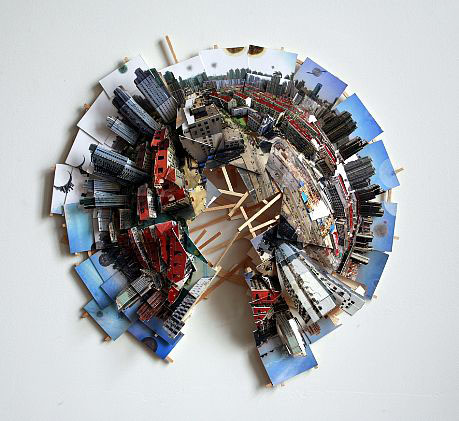
At the MoCP here at Columbia College Chicago, there were quite a few pieces of art that had caught my interest or made me look twice at it. But there was one that kept pulling me back. The Shanghai Planet 2008 by Isidro Blasco was a mixture of different medias that created this one piece that looked somewhat like a three dimensional planet popping out from the wall it was being displayed on. The small artist statement that was provided stated that this piece of art “combines architecture, photo, and installation to explore theory of vision and perception in relation to physical experience within each sculpture the viewer is encouraged to become.
If you look closely at this piece, you can see that what makes this piece pop out from the wall are small wooden beams that were constructed to not only support this piece so that it does not fall, but it is also shaped in a dome like structure showing the audience half of the planet. On the wooden beams it shows different photographic images of Shanghai. Some images show the neighborhoods, other the downtown city part of it, and other parts show the expressway/roads used there In Shanghai. On t he outer ring part of this planet, there are photographs of other smaller planets similar to that of the Shanghai planet. On each image, if you look really close, you can see that the artist wrote the name of each planet in the image. One was of Buenas Aires, another was of Argentina, and so forth it continues in this same manner. Each one similar yet different in its own way.
Friday, October 9, 2009
MCA - Cindy, 1988
 Chuck Close, Cindy, 1988. Collection Museum of Contemporary Art, Chicago. Gift of Camille Oliver-Hoffmann in memory of Paul W. Oliver-Hoffmann. © 1988 Chuck Close
One piece of art that intrigued me at the MCA was the one of Cindy, by Chuck Close. From a distance all you can see is just the image of this person. If it was a photograph I would say that it looked pixilated as an image. But once you get up close, you can see that it is not pixilated nor is it a photograph but a painting done in what I call “spot strokes”. My reason for calling it “spot strokes” is because the painting is done in dots of different colors to make one image when you step back.
The painting is called Cindy because it is a painting image of Cindy Sherman. The other work of Chuck Close is similar to this one of Cindy. They are done up close and done with lots of different colors that make a whole image when you step back. The technique of “spot strokes,” using different color dots and placing or painting them close together so that it makes a whole image, reminds me of the one painting "Sunday Afternoon on the Island of La Grande Jatte", by Georges Seurat . This painting is done in the same/similar manner.
Wednesday, September 23, 2009
Photo Sem - 3 Artists
 Anne Geddes
The first time I saw an Anne Geddes picture, I was probably about ten years old. The picture was of three babies coming/peeking out from a flower pot. My first thought of it was, "aww so cute". But as I grew older, and saw a whole calandar full of her pictures of babies looking like flowers or some type of fruit; I began to wonder how did Anne Geddes was ever able to get those babies to stay still in the position she had them. As years go on, to this day, I had liked more of her black and white pictures vs the ones in color. Her black and white pictures seem to have a more power full effect and more meaning to them than her colored pictures that seem more fun and entertainment like.
Anne Geddes was born September 1956 in Queensland, Australia. Most of Anne's work consist of babies or young children that are dressed as fictitious characters such as fairytale creatures, flowers, and/or animals. She is a self-taught photographer, never having taken any photo classes when she was at school. Has a husband and four daughters, all who live with her in New Zealand. In 1997 she was awarded a Lifetime Membership in the Professional Photographers of America and has an Honorary Fellowship with the New Zealand Institute of Professional Photographers.
Check out Anne Geddes at: http://www.annegeddes.com/Default.aspx
 Ansel Addams
Born February 20, 1902 and died April 22, 1984. I recognize Ansel Adams as a great landscape photographer. The picture that is shown on here is by far one of my favorite pictures that he has done. The way the sunlight falls on the mountain and the entire composition of the picture itself, for me, it’s breath taking. Ansel was an American photographer and an environmentalis. He was best known for his black and white photographs of the "American West" and "Yosemite National Park". In 1966, he was elected as a fellow of the American Academy of Arts and Scriences and in 1980 he was awarded the Presidential Medal of Freedom by Jimmy Carter himself.
Check out more Ansel Adams at: http://www.anseladams.com/
-mona-lisa.jpg) Leonardo da Vinci
Leonardo da VinciBorn April 15, 1452 and died May 2, 1519. He was a well-known mathmatician, scientist, sculptor, painter, muscian, etc. One of Leonardo da Vinci’s most famous pieces of art is of the "Mona Lisa", as well as "The Last Supper". He was very intrigued with the idea of flight and human anatomy.
More informaton about Leonardo da Vinci at: http://library.thinkquest.org/3044/
*Extra Artist*

Alejandro Rosado
Local Chicago graphic illustrator artist, Alejandro Rosado was born and raised in Chicago, IL. Born August, 1978, he is a Columbia College Alumni. His work consists of vector art, stroyboards, silk screening t-shirts, sketches, etc. One of his most great accomplishments is his comic book called “Sofa Kingdom”. The authors of this comic book is himself and his friend Reef. Alejandro is also the illustrator of this comic book. Sofa Kingdom is a comic about three kids (Alex, Reef, David, and Jetta the dog) growing up and having some crazy and great adventures.
Chech out his site at: http://www.myspace.com/alero78 or http://aleroart.com/index.html
Subscribe to:
Posts (Atom)